
Can AI Replace Medical Billing Jobs?
No—AI is not fully replacing medical billing jobs, but it is transforming how they are performed. AI automates repetitive tasks, while human professionals remain essential for accuracy, compliance, and decision-making.
Key Takeaways:
- AI handles routine billing tasks, not full job replacement
- Human oversight is still required for compliance and complex cases
- Medical billing roles are evolving, not disappearing
Why This Question Matters Now
AI in healthcare is growing fast, especially in administrative areas like billing and coding. Many professionals worry about job security, but the reality is more nuanced. Instead of elimination, roles are shifting toward higher-value responsibilities.
According to healthcare industry trends, automation improves efficiency but still requires trained professionals to manage exceptions and ensure compliance. This aligns with compliance standards that prohibit misleading guarantees about job outcomes and emphasize realistic career framing .
What Does AI Actually Do in Medical Billing?
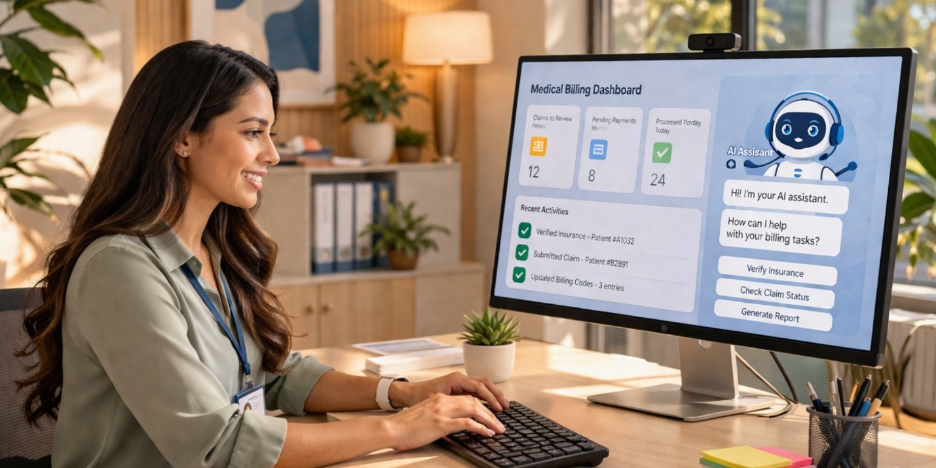
AI in medical billing focuses on automation, accuracy, and speed. It reduces manual workload but doesn’t replace the need for human judgment.
Key Tasks AI Can Handle:
- Automated claim submission
- Error detection and flagging
- Insurance eligibility checks
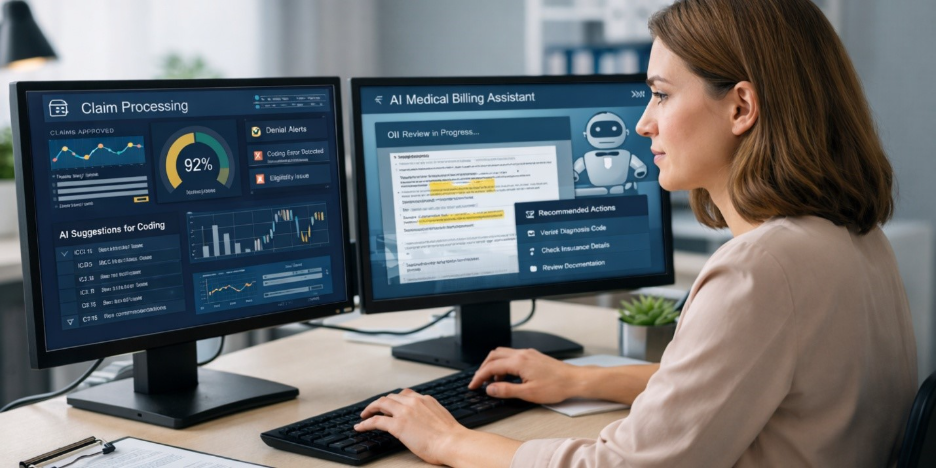
- Coding suggestions (not final decisions)
AI tools can process large volumes of data quickly, but they rely on structured inputs and still require validation.
What Tasks Still Need Human Medical Billers?
Even with AI, many responsibilities remain human-driven.
Human-Centered Responsibilities:
- Resolving claim denials
- Communicating with insurance providers
- Handling complex or unusual cases
- Ensuring compliance with regulations
- Verifying coding accuracy
These tasks require critical thinking and adaptability, areas where AI is limited.

AI vs Human Medical Billing: What’s the Difference?
| Function | AI Capabilities | Human Role |
| Data Entry | Automated | Oversight & corrections |
| Coding Suggestions | Predictive assistance | Final validation |
| Claim Processing | Fast automation | Exception handling |
| Compliance | Rule-based alerts | Interpretation & accountability |
| Patient Communication | Limited | Full responsibility |
This comparison shows that AI supports, rather than replaces, medical billing professionals.
Will AI Replace Medical Billing Jobs in the Future?
The better question is: How will AI change medical billing jobs?
AI is expected to:
- Reduce repetitive administrative work
- Increase demand for tech-savvy professionals
- Shift roles toward auditing, analysis, and compliance
Healthcare organizations still need trained professionals to ensure accuracy and meet regulatory standards.
What Skills Do You Need to Stay Relevant?
To adapt to AI in medical billing, you should focus on:
In-Demand Skills:
- Medical coding knowledge (ICD-10, CPT)
- Understanding of healthcare regulations
- Familiarity with billing software and AI tools
- Attention to detail and problem-solving
- Communication skills
Programs like those offered at ICOHS College are designed to help students develop practical, job-ready skills in evolving healthcare environments.
Are Medical Billing Jobs Still a Good Career?
Yes, medical billing remains a viable career path, especially for those willing to adapt. According to the U.S. Bureau of Labor Statistics, Healthcare administrative roles continue to grow due to increasing demand for healthcare services and digital record systems.
Important: Career outcomes vary by individual, and no job placement or salary is guaranteed, in alignment with compliance standards.
Conclusion: AI Is a Tool, Not a Replacement
AI is changing medical billing jobs, but it is not replacing them entirely. Instead, it is reshaping the role into something more efficient and technology driven.
If you focus on building relevant skills and staying adaptable, you can position yourself for long-term success in this evolving field.
FAQs
Q1: Will AI eliminate medical billing jobs completely?
No. AI automates routine tasks, but human professionals are still needed for complex decision-making and compliance.
Q2: Is medical billing a stable career with AI growth?
Yes. Medical billing remains in demand, especially for individuals with updated technical and regulatory skills.
Q3: What is the biggest change AI brings to medical billing?
The biggest change is automation of repetitive tasks, allowing professionals to focus more on problem-solving and oversight.