

How does AI change healthcare office jobs?
AI changes healthcare office jobs by automating repetitive administrative tasks, improving data accuracy, and helping staff work more efficiently. Instead of replacing roles, AI reshapes responsibilities so employees can focus on communication, coordination, and patient support.
Key Takeaways:
- AI reduces manual tasks like scheduling and billing
- Healthcare office jobs now focus more on patient interaction and problem-solving
- New digital skills are becoming valuable in administrative healthcare roles

Why is AI becoming common in healthcare office jobs?
AI is becoming a core part of healthcare office jobs because administrative workloads continue to grow. Tasks like appointment scheduling, insurance verification, and medical record management require time and precision. AI tools help streamline these processes while reducing human error.
Organizations are adopting AI to improve operational efficiency and patient experience. According to the U.S. National Library of Medicine, AI is increasingly used to support healthcare workflows and data management. This shift does not eliminate healthcare office jobs—it changes how they function. Employees are now expected to work alongside digital tools rather than perform everything manually.
What tasks in healthcare office jobs are automated by AI?
AI handles repetitive, time-consuming tasks that were traditionally done manually. This allows healthcare office staff to focus on higher-value responsibilities.
Common Tasks AI Can Support:
- Appointment scheduling and reminders
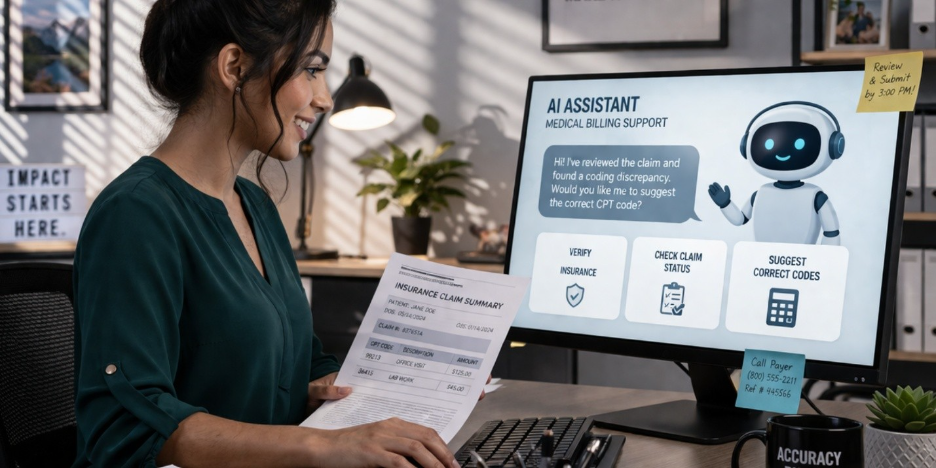
- Medical billing and coding assistance
- Data entry and record organization
- Insurance eligibility checks
- Patient communication via chatbots
These changes make healthcare office jobs more efficient and less prone to administrative delays.
How does AI improve daily workflows in healthcare offices?
AI improves workflows by organizing information faster and reducing bottlenecks. Instead of switching between multiple systems, staff can rely on integrated AI tools to manage tasks.
Example Workflow Improvement:
- AI flags missing patient information automatically
- Systems suggest appointment availability in real time
- Billing errors are detected before submission
This allows healthcare office jobs to run more smoothly and helps reduce stress caused by manual errors.

What skills are needed for AI-supported healthcare office jobs?
As AI changes healthcare office jobs, the skill set required is also evolving. You don’t need to become a programmer, but digital literacy is becoming essential.
Key Skills to Develop:
- Familiarity with healthcare software systems
- Basic data management and accuracy
- Communication and patient coordination
- Problem-solving using digital tools
- Adaptability to new technologies
Programs like those offered at ICOHS College are designed to help students build practical, job-ready skills that align with modern healthcare environments. Graduates may pursue roles such as Medical Coding Specialist, AI Billing Integration Specialist, or Medical Billing Specialist. (Outcomes vary by individual.)
AI vs Traditional Healthcare Office Jobs
| Task Area | Traditional Process | AI-Supported Process |
| Scheduling | Manual phone/email booking | Automated scheduling systems |
| Data Entry | Hand-entered records | AI-assisted data population |
| Billing | Manual coding checks | AI error detection & suggestions |
| Patient Communication | Staff-managed calls | Chatbots + automated reminders |
| Workflow Efficiency | Slower, manual coordination | Streamlined, integrated systems |
This comparison highlights how AI changes healthcare office jobs by improving efficiency rather than replacing roles.
Does AI replace healthcare office jobs or support them?
AI is more commonly used to support healthcare office jobs rather than replace them. While some repetitive tasks are automated, human involvement is still essential for communication, decision-making, and patient interaction.
Healthcare offices still rely on trained professionals to:
- Handle sensitive information
- Communicate with patients empathetically
- Resolve complex administrative issues
AI acts as a tool, not a replacement. It enhances productivity and allows staff to focus on meaningful work.
How can you prepare for AI-driven healthcare office jobs?
If you’re interested in healthcare office jobs, preparing for AI integration can give you a strong advantage.
Steps to Get Started:
- Learn basic healthcare administration skills
- Get familiar with digital tools and software
- Build communication and organizational abilities
- Explore training programs focused on real-world applications
Conclusion
AI changes healthcare office jobs by making them more efficient, organized, and technology driven. Instead of removing jobs, it reshapes them into roles that require both human interaction and digital skills.
If you’re considering a career in this field, understanding how AI works alongside administrative tasks can help you stay competitive. With the right training and adaptability, healthcare office jobs can offer stable and evolving career opportunities in a technology-driven environment.
FAQs
Q1: Will AI eliminate healthcare office jobs?
No. AI is designed to support healthcare office jobs by automating repetitive tasks. Human roles remain essential for communication and coordination.
Q2: What are examples of AI tools used in healthcare offices?
Examples include scheduling software, billing automation systems, and AI chatbots for patient communication.
Q3: Do I need technical skills to work in AI-supported healthcare office jobs?
Not necessarily. Basic digital skills and familiarity with software systems are typically sufficient for many entry-level roles.