
8 Integrative Health Careers You Can Pursue With an Associate Degree
Integrative health careers cover more ground than most people expect. Bodywork, coaching, fitness instruction, nutrition education, and wellness program management all sit under the same umbrella. If you have been assuming that any career touching health and the human body requires a four-year degree and a clinical license, that assumption is worth revisiting. Many entry points into this field are built around certifications and applied skills rather than licensure, which is why a two-year associate degree can be a realistic starting point.
Here is the direct answer. An associate degree in integrative health can prepare you for integrative health careers such as massage therapist, health and wellness coach, personal trainer, group fitness instructor, health educator, and wellness program coordinator. What it does not do is qualify you for licensed clinical practice, which is a separate pathway with separate requirements. Outcomes vary by individual, and the credential you actually need depends on the specific role and the state where you work.
Three things worth knowing before you read further:
- Most integrative health careers are entered through certification and applied training rather than state licensure. Massage therapy is the notable exception in many states, including California.
- Pay and demand vary sharply by role. The U.S. Bureau of Labor Statistics reported a May 2024 median annual wage of $57,950 for massage therapists and $46,180 for fitness trainers and instructors, with different growth projections behind each.
- Several roles in this field, including health coach and holistic health practitioner, are not tracked as separate occupations by the BLS. Public wage data for them is thin, and any figure you see quoted should be treated with caution.
What Is Integrative Health, Exactly?
Integrative health is an approach to wellbeing that combines conventional health knowledge with complementary practices, treating movement, nutrition, stress, sleep, and manual therapy as connected parts of one picture rather than separate problems. The emphasis is on the whole person and on prevention, not on diagnosing or treating disease.
You will see the term used almost interchangeably with “holistic health” in job listings and program names. The difference is mostly one of emphasis. Integrative approaches are typically described as working alongside conventional medical care. Holistic approaches tend to be framed on their own terms. That distinction matters practically, because a hospital wellness department and an independent bodywork studio are usually looking for different things. It also shapes how integrative health careers are titled, since the same set of skills may be advertised under either label.
What Does an Associate Degree in Integrative Health Actually Cover?
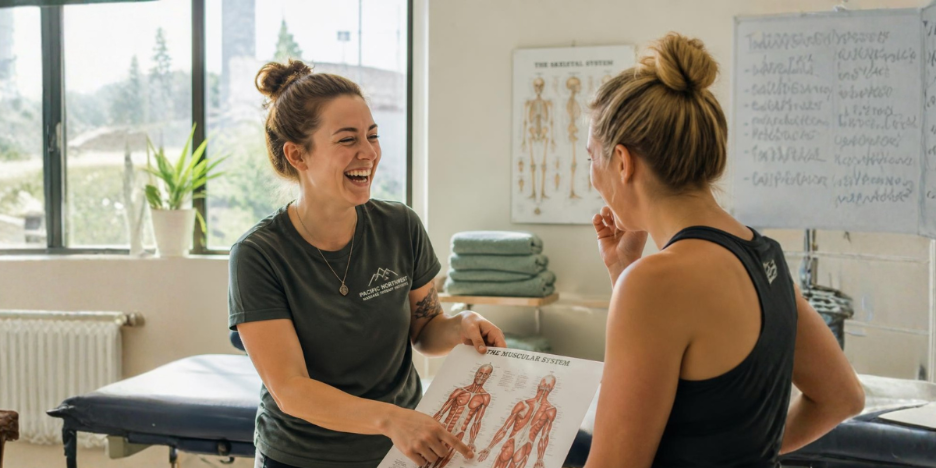
An associate degree in integrative health is generally built to do two jobs at once. It gives you the science foundation, including anatomy, physiology, and body systems, and it layers applied skills on top of that foundation so you can work with clients rather than only study concepts.
Programs such as those offered by ICOHS College illustrate the pattern. The ICOHS program runs approximately 105 weeks, or a little over two years, and is available in a hybrid format combining online coursework with in-person labs, or fully online. It awards an Associate of Science in Integrative Health.
The Coursework Behind the Credential
Curriculum in this field typically clusters into four areas. Understanding the clusters helps you predict which integrative health careers a given program actually prepares you for:
- Science and anatomy: musculoskeletal anatomy, body systems, kinesiology, and considerations for special populations such as older adults and clients in pregnancy.
- Hands-on modalities: Swedish and deep tissue technique, myofascial release, trigger point therapy, cupping, sports massage, and Eastern systems including Shiatsu, Thai massage, and Tui Na.
- Coaching and nutrition: integrative nutrition principles, behavior change, active listening, goal setting, and supervised coaching practicums.
- Business and communication: marketing, client acquisition, ethics, leadership, business math, and in some programs, applications of artificial intelligence and data analysis in health settings.
That last cluster is easy to overlook and hard to overstate. A large share of work in holistic health careers is self-employed or contract-based, which means the business coursework is not filler. It is often the difference between holding a certification and running a practice.
8 Integrative Health Careers to Consider
The table below maps eight integrative health careers against what the work involves and what credentials typically get you in the door. Note the wage column carefully: the BLS tracks only some of these as distinct occupations.
| Role | What the work involves | Typical entry credential | BLS median wage, May 2024 |
| Massage Therapist | Soft tissue manipulation for pain relief, recovery, and relaxation in spas, clinics, or private practice | State certification or license where required; CAMTC certification in California | $57,950 |
| Personal Trainer | One-on-one exercise programming and coaching in gyms, studios, or clients’ homes | Industry certification; employers generally prefer certified trainers | $46,180 (fitness trainers and instructors) |
| Group Fitness Instructor | Leading class-based exercise sessions in gyms, studios, and community settings | Industry certification | $46,180 (fitness trainers and instructors) |
| Health Educator | Designing and delivering programs that teach communities about conditions affecting wellbeing | BLS lists a bachelor’s degree as typical entry-level education | $63,000 |
| Community Health Worker | Connecting people to health resources and social services; promoting healthy behaviors | BLS lists a high school diploma as typical entry-level education | $51,030 |
| Health and Wellness Coach | Guiding clients through behavior change around movement, nutrition, sleep, and stress | Industry certification; no state license in most jurisdictions | Not tracked separately by BLS |
| Holistic Health Practitioner | Combining bodywork and wellness education in an independent or studio practice | Varies by state and scope; not a licensed clinical title | Not tracked separately by BLS |
| Wellness Program Coordinator | Running wellness offerings for a spa, retreat, gym, or corporate employer | Varies; often certification plus operational experience | Not tracked separately by BLS |
Two patterns are worth pulling out of that table. First, the roles with the clearest public wage data are also the roles with the clearest credential pathways. Second, the roles that sound most senior, such as wellness program coordinator, are often the ones with the least standardized entry route, which usually means employers weigh experience heavily.
Hands-On Roles
Massage therapy is the most clearly defined pathway among integrative health careers, largely because it is the most regulated. The BLS projects employment of massage therapists to grow 15 percent from 2024 to 2034, much faster than the 3 percent average across all occupations, with about 20,400 openings projected each year over that decade. The reported median annual wage was $58,450 in May 2025.
In California, massage professionals are certified through the California Massage Therapy Council. CAMTC certification requires a minimum of 500 hours of curricula from a CAMTC-approved school, a fingerprint-based background check, official transcripts sent directly from your school, and payment of the certification fee. State certification is technically voluntary, but many California cities and counties require it in practice, so most working therapists obtain it. Attending an approved school does not by itself result in certification. You apply separately and must meet every CAMTC requirement.
Coaching and Education Roles
Coaching roles are where the field is least regulated and, for that reason, most variable. A wellness coach career is generally built on certification plus demonstrated results rather than on licensure. That lowers the barrier to entry into a wellness coach career. It also means you are competing in a market where credentials are inconsistent and clients cannot easily tell one certification from another.
Health education is the more structured cousin of coaching. It is also the place where an honest caveat belongs: the BLS lists a bachelor’s degree as the typical entry-level education for health education specialists, and projects 4 percent growth from 2024 to 2034, roughly average. An associate degree may open assistant or coordinator roles in this space, but the specialist title itself often expects more schooling.
Program and Facility Roles
Spa coordinators, retreat managers, and corporate wellness coordinators sit on the operations side. These positions draw on the business half of an associate degree in integrative health: scheduling, marketing, client retention, budgeting, and program design. They tend to be reached after a few years of hands-on work rather than directly out of a degree program, though that varies by employer.
How Much Do Integrative Health Careers Pay?
Pay across integrative health careers is wide-ranging, and averages hide more than they reveal. The figures below come from the BLS Occupational Employment and Wage Statistics survey for May 2025, alongside employment projections through 2034.
| Occupation | Median annual wage | Projected growth, 2024–34 | Annual openings |
| Massage therapists | $57,950 | 15% (much faster than average) | About 24,700 |
| Health education specialists | $63,000 | 4% (about average) | About 7,900 |
| Community health workers | $51,030 | 11% (much faster than average) | About 7,800 |
| Fitness trainers and instructors | $46,180 | 12% (much faster than average) | About 74,200 |
| All occupations, for comparison | $49,500 | 3% | — |
Read those medians with two caveats attached. Part-time work is common across several of these occupations, so a median annual figure does not necessarily describe what a part-time schedule produces. And BLS wage data is drawn from employer-reported payroll, which means self-employed practitioners are underrepresented. In a field where independent practice is common, that gap matters. Earnings across integrative health careers vary by experience, setting, location, and hours worked, and individual results vary.
Integrative Health Practitioner vs. Licensed Clinician: What Is the Difference?
This is the distinction to understand before you enroll in anything, and it is the one prospective student exploring integrative health careers most often get wrong.
An integrative health practitioner works within a wellness scope of practice. You support clients through bodywork, movement, education, and behavior change. A licensed clinician, such as a physical therapist, registered dietitian, registered nurse, or licensed acupuncturist, works within a clinical scope defined by state law. Those roles require specific degrees, supervised hours, and state licensure that an associate degree in integrative health does not provide.
| Wellness scope | Clinical scope | |
| What you do | Educate, coach, apply bodywork, support healthy behaviors | Assess, diagnose, and treat conditions |
| Typical credential | Certification; state certification for massage in many states | Graduate or professional degree plus state licensure |
| Example titles | Health coach, personal trainer, massage therapist, wellness coordinator | Physical therapist, registered dietitian, nurse, acupuncturist |
| Language to avoid | Do not describe services as diagnosis, treatment, or medical nutrition therapy | Governed by state practice acts |
The practical consequence shows up in how you describe your own work. A nutrition consultant with a wellness credential can teach general nutrition principles. Providing medical nutrition therapy for a diagnosed condition is a regulated activity that belongs to registered dietitians in most states. Staying on the right side of that line protects your clients and protects you, and every integrative health practitioner is responsible for knowing where it sits in their own state.
How Do You Build a Wellness Coach Career?
Because the coaching side of the field is unregulated, building a wellness coach career is less about clearing a licensing hurdle and more about assembling credibility deliberately. It is one of the more accessible integrative health careers to enter and one of the harder ones to sustain. A workable sequence looks like this:
- Get the foundational science first. Anatomy, physiology, and basic nutrition science are what separate a coach who can reason about a client’s situation from one who repeats scripts.
- Earn a recognized certification. Look for programs with published standards, a proctored exam, and continuing education requirements rather than a same-day online credential.
- Practice under supervision. Coaching practicums and supervised client hours are where technique becomes judgment. Prioritize programs that include them.
- Pick a population. Coaches who work with a defined group, such as postpartum clients, desk-bound professionals, or people managing chronic stress, tend to find it easier to get referrals than generalists.
- Learn the business mechanics. Pricing, scheduling, contracts, insurance, and client retention determine whether a practice is sustainable. Treat this as a core skill, not an afterthought.
- Stack a second credential. Many practitioners pair coaching with massage, personal training, or group fitness so that income is not dependent on a single service.
How Do Holistic Health Careers Differ From Conventional Healthcare Roles?
The clearest difference is orientation. Conventional healthcare roles are largely organized around identifying and treating specific conditions. Holistic health careers are organized around supporting overall function, prevention, and daily habits, which is why holistic health careers tend to emphasize education and coaching skills.
That difference shows up in the work environment too. Conventional clinical roles are concentrated in hospitals, physician offices, and licensed facilities. Holistic health careers are spread across spas, gyms, wellness centers, retreat properties, corporate wellness programs, and independent practices. The trade-off is real in both directions: clinical settings tend to offer more schedule stability and benefits, while independent wellness practice tends to offer more autonomy and more income variability.
Where Integrative Health Careers May Not Be the Right Fit
Integrative health careers suit some people well and do not suit others. Being clear about the limits is more useful than a list of upsides.
- You want to become a licensed clinician. If the goal is physical therapy, nursing, dietetics, or acupuncture, this is not the pathway. Those careers require different degrees and state licensure, and credits may not transfer toward them.
- You need predictable income right away. Self-employment and part-time scheduling are common in this field. Building a full client base typically takes time, and early income is often uneven.
- The physical demands do not fit your situation. Bodywork is manual labor. Therapists commonly manage the strain on hands, wrists, shoulders, and back, and many limit the number of sessions they take per week for that reason.
- You are targeting the health education specialist title specifically. The BLS lists a bachelor’s degree as typical entry-level education for that occupation, so an associate degree may position you for adjacent roles rather than that one.
- You want a role that public data describes clearly. Several titles in this field are not separately tracked by the BLS, which makes it harder to research realistic pay and demand before committing.
How to Decide If This Path Fits You
- Name the role, not the field. Integrative health careers are too broad to research as a category. “Massage therapist in a chiropractic clinic” is researchable. “Something in wellness” is not.
- Check the regulation in your state. Search your state’s requirements for that specific title before you compare programs, because the answer changes what training you need.
- Match the program to the credential. Confirm that a program’s hours and approvals line up with the certification you are aiming for.
- Look at the labs, not the brochure. Ask how many supervised hands-on hours are included and how clinical practice is arranged.
- Talk to someone doing the work. Ask a practitioner in your target role what their weekly schedule and income actually look like. This is the fastest reality check available.
- Verify the details in writing. Program length, delivery format, certifications included, and total cost should all be confirmed directly with the school before you enroll.
The Bottom Line
Integrative health careers are accessible through a two-year degree in a way that many health-adjacent fields are not, and the range of roles is wider than most people realize. The field rewards people who like working directly with clients, who are comfortable with a degree of self-direction, and who are willing to treat the business side as seriously as the technique.
The honest framing is this: an associate degree in integrative health opens a set of doors, not a guaranteed outcome. Which doors depends on which certifications you complete, which state you practice in, and how deliberately you build experience after graduation. Start by naming the specific role you want, then work backward to the training that role actually requires.
Frequently Asked Questions
What is integrative health in simple terms?
Integrative health is an approach that combines conventional health knowledge with complementary practices such as bodywork, movement, and nutrition education, focusing on the whole person and on prevention rather than on treating a single symptom. It is generally described as working alongside conventional medical care, not as a replacement for it.
Can you get into integrative health careers with just an associate degree?
For many roles, yes. Massage therapy, personal training, group fitness instruction, and health coaching are typically entered through certification rather than a four-year degree. Some titles, including health education specialist, list a bachelor’s degree as typical entry-level education according to the BLS. Requirements vary by role, employer, and state, and outcomes vary by individual.
Is a health coach the same as an integrative health practitioner?
Not quite. Health coach usually refers to a specific certification focused on behavior change, while integrative health practitioner is a broader descriptor that may include bodywork alongside wellness education. Neither is a licensed clinical title, and neither permits diagnosing or treating medical conditions. Check how your state regulates the integrative health practitioner title, or any other title you plan to use, before using it professionally.
Do I need a license to practice massage in California?
California does not issue a state massage license. It uses a voluntary certification administered by the California Massage Therapy Council, which requires a minimum of 500 hours of curricula from a CAMTC-approved school, a background check, and official transcripts. Many cities and counties require CAMTC certification in practice. Confirm current requirements directly with CAMTC, since fees and policies change.