

Remote IT jobs have shifted from a temporary experiment to a standard way technology teams operate. If you are researching remote IT jobs right now, here is the short answer: most employers screen for a verifiable technical foundation, at least one industry certification, a stable home setup, and strong written communication. Nothing about remote work removes the need for real skill — it simply changes where that skill is applied.
This guide walks through the remote IT job requirements employers commonly list, the skills needed for remote IT jobs, which entry level remote IT jobs exist, and a practical path for anyone starting out. Outcomes vary by individual, and the goal here is clarity rather than promises.
What Are Remote IT Jobs?
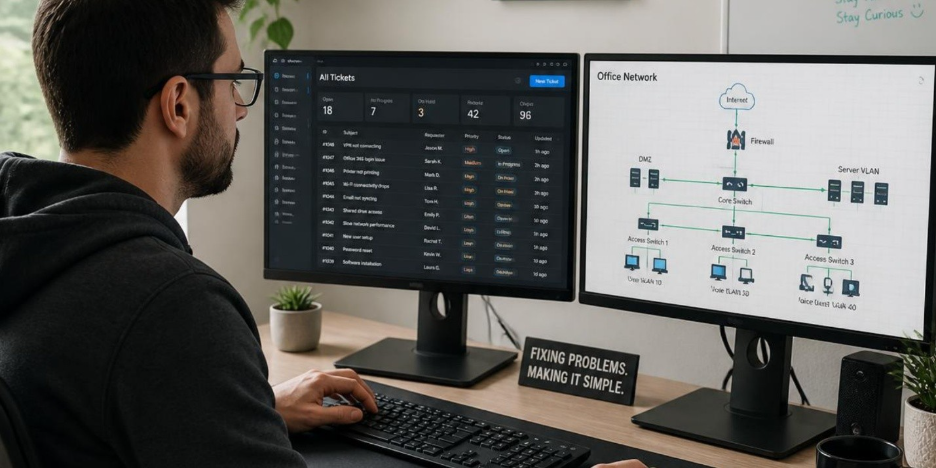
Remote IT jobs are information technology roles performed entirely or mostly outside a traditional office, using remote access tools, ticketing systems, and cloud platforms. Common examples include help desk support, network operations, systems administration, and security monitoring.
The work translates well to a distributed setup because the systems being supported are already networked. A technician resetting an account, imaging a laptop, or reviewing firewall logs can often do that work from anywhere with a secure connection. That is why remote IT jobs appear across corporate IT departments, managed service providers, healthcare systems, and government contractors.
Not every technology role is remote-friendly, though. Hardware repair, data center work, and on-site installations still require physical presence. Many remote IT jobs are hybrid rather than fully remote.

Why Remote IT Jobs Are Common in Technology
Federal data supports what job seekers already notice. According to the U.S. Bureau of Labor Statistics Current Population Survey, 65.4 percent of workers in computer and mathematical occupations teleworked in 2025, and 36.1 percent teleworked all of their hours. Across all occupations, the telework rate was 22.4 percent.
That gap explains why remote IT jobs are easier to find than remote roles in most other fields. It does not mean every posting is open to beginners. Fully remote listings often attract national applicant pools, so competition can be significant.
7 Remote IT Job Requirements Employers Commonly List
Job descriptions vary by employer, but the same requirements appear again and again. Here are seven worth preparing for.
1. A Verifiable Technical Foundation
Employers want evidence you can troubleshoot hardware, operating systems, and networks. That evidence usually comes from coursework, lab work, a home lab, or documented prior experience.
2. At Least One Recognized Certification
Certifications such as CompTIA A+, Network+, and Security+ give hiring managers a common reference point. For remote IT jobs for beginners, a certification often carries more weight than an unrelated degree because it maps directly to the tasks in the job description.
3. A Reliable Home Network and Workspace
Many postings specify a minimum internet speed, a wired connection, and a private space for handling sensitive information. This is one of the remote IT job requirements candidates most often overlook.
4. Documented Troubleshooting Experience
Remote support means diagnosing problems you cannot see. Employers look for candidates who can describe a structured process: gather information, isolate variables, test, resolve, and document.
5. Clear Written Communication
Ticket notes, escalation summaries, and chat messages replace hallway conversations. Among the skills needed for remote IT jobs, writing clearly is one of the most consistently requested.
6. Security and Compliance Awareness
Working outside a corporate network raises risk. Familiarity with multifactor authentication, VPN use, device encryption, and data handling rules is now expected in most remote IT jobs.
7. Schedule and Time Zone Flexibility
Support teams often cover extended hours. Candidates who can work early, late, or weekend shifts frequently have more options among entry level remote IT jobs.

Skills Needed for Remote IT Jobs
The skills needed for remote IT jobs fall into two groups: technical ability and self-directed work habits. Both matter, and neither substitutes for the other.
Technical Skills
- Windows, macOS, and Linux fundamentals
- Networking basics such as TCP/IP, DNS, DHCP, and subnetting
- Active Directory and identity management
- Remote desktop and endpoint management tools
- Ticketing platforms and knowledge base documentation
- Cloud fundamentals in Microsoft 365, Azure, or AWS
- Basic scripting with PowerShell or Bash
Workplace Skills
- Independent time management without direct supervision
- Patience and empathy when users are frustrated
- Written clarity across chat, email, and ticket systems
- Comfort asking for help in an asynchronous environment
- Consistent documentation habits
Entry Level Remote IT Jobs to Research
If you are mapping out entry level remote IT jobs, these roles appear most often in listings. Wage figures below come from the Bureau of Labor Statistics and reflect national medians, not what any individual will earn.
| Role | What You Do | BLS Median Wage, May 2024 |
| Computer user support specialist | Help end users with software, hardware, and access issues | $60,340 |
| Computer network support specialist | Monitor networks, test performance, and resolve connectivity problems | $73,340 |
| Information security analyst | Watch for threats, review alerts, and support security controls | $124,910 |
Wages vary by employer, location, industry, and experience. Outcomes vary by individual.
One limitation deserves mention. The Bureau of Labor Statistics projects overall employment of computer support specialists to decline 3 percent from 2024 to 2034, even though about 50,500 openings are projected each year from workers leaving the occupation. Broader computer and information technology employment is projected to grow much faster than average over the same period. Careerplanner Bureau of Labor Statistics
How to Get a Remote IT Job: A 6-Step Path
If you are wondering how to get a remote IT job without prior technology experience, treat it as a sequence rather than a single application push.
Step 1: Choose a Starting Track
Support, networking, and security are the three most common entries. Pick one and go deep instead of sampling all three.
Step 2: Build Verifiable Skills
Structured training programs, community college courses, and self-study all work. What matters is that you can demonstrate the skill, not where you learned it.
Step 3: Earn a Foundational Certification
CompTIA A+ is the usual starting credential for support roles, with Network+ and Security+ as common next steps. Passing an exam is your responsibility, and preparation time differs from person to person.
Step 4: Create Proof of Work
A home lab, a documented project, or a GitHub repository of scripts gives you something concrete to discuss. This is one of the fastest ways to stand out for remote IT jobs for beginners.
Step 5: Write a Remote-Ready Resume
Name the tools you have used, describe your troubleshooting process, and mention your home setup and availability. Recruiters filtering for remote IT jobs scan for those specifics.
Step 6: Apply Strategically
Search company career pages and remote-focused job boards, not only large aggregators. Consider hybrid postings too, since many teams convert them to remote after onboarding.
Remote IT Jobs for Beginners: Setting Realistic Expectations
It helps to know what the first year usually looks like. Many remote IT jobs for beginners start on a hybrid or on-site basis, then move remote once you have shown you can work independently. Some employers require a probationary period in the office.
Tier 1 support is where most people begin. The work is repetitive by design, and that repetition is how you build pattern recognition. Compensation at the entry level typically sits below the medians listed earlier.
Progression is also not automatic. Moving from help desk to network administration or security analysis generally takes additional certifications and demonstrated results. Graduates have pursued roles such as IT support specialist, help desk analyst, network technician, and junior systems administrator, though outcomes vary by individual.
Where Structured Training Fits In
Self-teaching works for some people. Others do better with a scheduled program, instructor access, and lab environments. ICOHS College offers information technology programs in San Diego designed to prepare students for entry-level technical roles, including the IT Network Specialist certificate and an Associate of Science in Information Technology. Both are available in online and hybrid formats.
Financial aid is available to those who qualify, and eligible students may apply. Veterans and service members should speak with an admissions advisor about which VA education benefits apply to specific programs, as eligibility depends on program approval status.
Key Takeaways
- Remote IT jobs are widely available, with 65.4 percent of computer and mathematical workers teleworking in 2025 according to federal data.
- The core remote IT job requirements are a verifiable technical foundation, a recognized certification, a reliable home setup, and clear written communication.
- Entry level remote IT jobs cluster in help desk support, network support, and junior security roles.
- The skills needed for remote IT jobs combine technical ability with independent work habits and documentation discipline.
- Knowing how to get a remote IT job is mostly about sequencing: pick a track, build skills, certify, document proof of work, then apply with a remote-ready resume.
Remote IT jobs reward preparation. Start with one track, one certification, and one project you can talk about in detail, and build from there. Outcomes vary by individual.
FAQs
Q: Can you get remote IT jobs with no experience?
A: Some entry level remote IT jobs are open to candidates without prior professional experience, particularly tier 1 help desk roles. Employers typically expect a foundational certification such as CompTIA A+ and evidence of hands-on practice. Many beginners start hybrid and transition to fully remote later. Outcomes vary by individual.
Q: What are the most common remote IT job requirements?
A: The most common remote IT job requirements are a demonstrated technical foundation, at least one industry certification, a reliable high-speed home internet connection, a private workspace, clear written communication, and security awareness. Some employers also require overlap with a specific time zone.
Q: What skills are needed for remote IT jobs?
A: The skills needed for remote IT jobs include operating system fundamentals, networking basics such as TCP/IP and DNS, identity management, ticketing systems, and cloud platform familiarity. Independent time management, written clarity, and consistent documentation are equally important.
Q: How long does it take to prepare for remote IT jobs for beginners?
A: Preparation time varies widely based on prior background, study hours per week, and the certification path chosen. Certificate programs commonly run several months to about a year, while degree programs take longer. Individual results vary.
Q: Do remote IT jobs pay less than on-site roles?
A: Pay depends on employer, location, and role rather than remote status alone. Some companies adjust compensation by geography while others use national bands. The Bureau of Labor Statistics reports a May 2024 median wage of $105,990 across computer and information technology occupations, though that figure covers all work arrangements.
Q: Is a degree required for remote IT jobs?
A: A degree is not universally required. Many employers accept certifications plus demonstrated skill for support and network roles, while some larger organizations and security positions prefer a degree. Requirements vary by employer.
ICOHS College Program
Build Technical Skills in Information Technology and Cyber Security
Related Blogs
7 Positive Reasons an Associate Degree in IT May Be Worth It